featherless_ai_logo

Featherless

Rating: 4.4/5
User Satisfaction: 89%
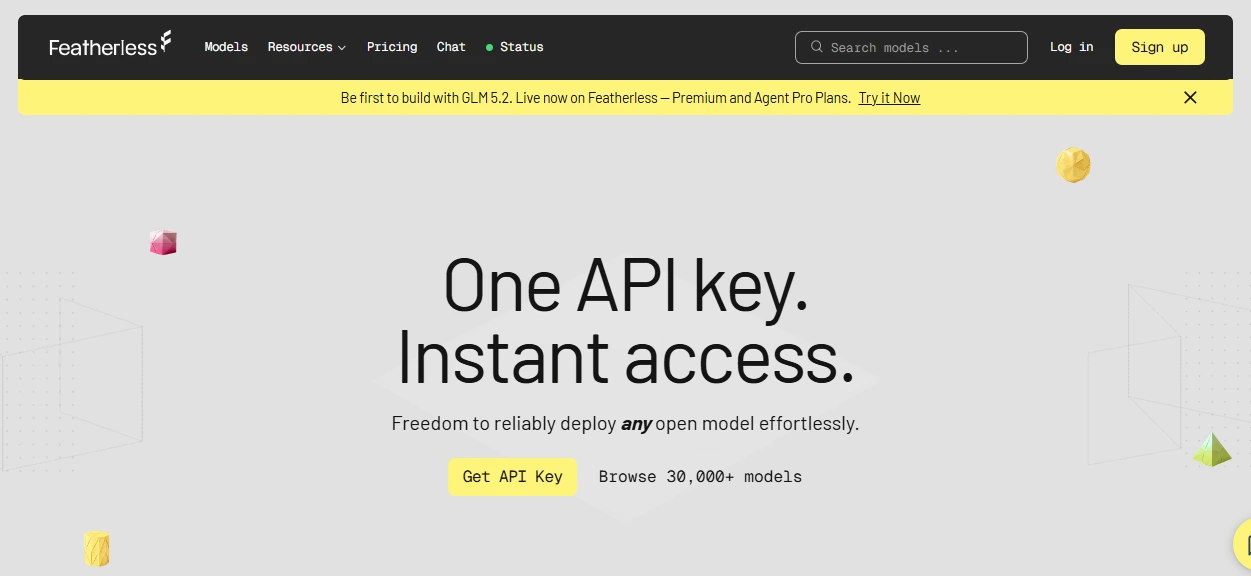
Featherless is a tool that provides serverless access to open-source AI models for developers and AI teams so they can build, test, and deploy AI apps without running their own infrastructure

Alternative To

  • Together AI — Better for production-grade enterprise inference with stronger tooling and model optimization.
  • Replicate — Easier for running multimodal and generative AI workflows with pay-per-use billing.
  • Fireworks AI — Stronger performance tuning and low-latency inference for production applications.
  • OpenRouter — Better if you want one API layer across many commercial and open AI providers.
  • Groq — Faster inference speeds for supported open-weight models.

Overview

Featherless is a serverless AI inference platform focused on open-source models. Instead of hosting models yourself on expensive GPUs, you can access thousands of models through a single API.

The platform is built around Hugging Face-compatible workflows and OpenAI-style APIs, making it easier for developers to swap between models without rebuilding their stack.

It’s mainly aimed at developers, AI startups, research teams, agent builders, and hobbyists experimenting with open-weight LLMs.

Running large AI models is expensive and operationally messy. Most teams either:

  • pay for dedicated GPU infrastructure, or
  • use providers with limited model catalogs.

Featherless tries to solve both problems at once:

  • huge model variety,
  • no infrastructure management,
  • predictable subscription pricing.

It’s especially useful if you:

  • test many open-source models,
  • build AI agents,
  • run roleplay/chat apps,
  • prototype AI products quickly,
  • want alternatives to OpenAI-only workflows.

The “unlimited requests with concurrency limits” model is also attractive for heavy experimentation compared to token-based billing.

You connect to Featherless through an OpenAI-compatible API endpoint. The platform dynamically loads and serves models from a large catalog that includes:

  • Llama models,
  • Qwen,
  • DeepSeek,
  • roleplay fine-tunes,
  • coding models,
  • multimodal models.

The platform handles:

  • GPU allocation,
  • scaling,
  • model orchestration,
  • inference serving.

Developers can integrate through:

  • direct REST APIs,
  • OpenAI SDK compatibility,
  • LangChain,
  • LiteLLM,
  • Hugging Face Inference Providers.

Watch-outs

  • Pricing is concurrency-based rather than token-based, which can confuse new users.
  • Some advanced features available on enterprise AI providers are still limited.
  • Tool calling and structured outputs are not universally supported across all models.
  • Model quality varies heavily because the catalog includes many community fine-tunes.
  • Context length and performance depend on the selected model and plan tier.

Details

Tool Launch / Founded Date

2023-10-01 (approx.)

Best for

AI developers, indie hackers, startups, research teams, agent builders, open-source AI enthusiasts

Access Type

Paid subscription, API access, concurrency-based plans

Licensing Model

Featherless is proprietary infrastructure software. Users retain ownership of their prompts and outputs, though licensing restrictions depend on the underlying open-source model being used. Commercial usage rights vary by model license. The company states it is privacy-focused and does not log prompts for inference requests in standard operation.

Feature

Key Features

  • Access to thousands of open-source AI models through one API
  • Serverless architecture removes GPU management overhead
  • OpenAI-compatible API for easier migration
  • Hugging Face ecosystem integration
  • Supports chat, coding, roleplay, and multimodal models
  • Concurrency-based plans with unlimited requests
  • Dynamic model loading for large catalogs
  • LangChain and LiteLLM integrations
  • Useful for rapid AI prototyping and experimentation
  • Supports custom workflows across many model families

Cons / Limitations

  • Pricing model can be difficult to understand initially
  • Output quality varies significantly between community models
  • Enterprise governance features are less mature than larger competitors
  • Some models have slower cold-start behavior
  • Advanced tool-calling support is inconsistent across the catalog

Pricing Tables

Starter Plan
Starting at $10/month
  • Unlimited requests
  • Access to smaller model classes
  • Limited concurrency
  • Intended for interactive chat and experimentation
Mid-Tier Plans
Pricing varies
  • Higher concurrency limits
  • Access to larger models
  • Larger context windows
  • Better suited for coding and agent workloads
Scale / Enterprise Plans
Contact sales
  • High concurrency allocations
  • Large-scale inference support
  • Enterprise deployment support
  • Intended for production AI applications and teams

Analytics

Traffic Analysis

Domain Rating
Organic Traffic
Majority Users

Visits Over Time

No visit data found.

Traffic Sources

No traffic data found.

Last Update Date: 2026-05-19

FAQ

Can I use Featherless models commercially?
Usually yes, but it depends on the specific model license. Featherless provides the infrastructure layer, while the actual licensing rules come from the underlying model creators.
Does Featherless charge per token?
Not primarily. Featherless mainly uses a concurrency-based subscription model instead of traditional token billing, which can make costs more predictable for heavy users.
How many models are available?
The platform advertises access to over 24,000 models from the Hugging Face ecosystem, including Llama, Qwen, DeepSeek, and many fine-tuned variants.
Does Featherless support OpenAI SDKs?
Yes. The API is designed to be OpenAI-compatible, so many existing OpenAI integrations can work with minimal changes.
Can I use Featherless with LangChain or LiteLLM?
Yes. Featherless has integrations and examples for LangChain, LiteLLM, and Hugging Face workflows.
Does Featherless store prompts or inference logs?
The company publicly states that it does not log inference requests by default and positions itself as a privacy-focused provider.
What do higher-tier plans unlock?
Higher plans mainly increase: concurrency limits, supported model sizes, context window availability, scalability for agentic or coding workloads.

Related AI Tools

Kids Tell Tales is an AI storytelling tool that creates personalized children’s books for parents, educators, and young
Artypa is a tool that generates and edits AI images, videos, and audio for creators and brands so
GenscriptAI is an AI-powered scriptwriting tool that helps creators and media teams generate story ideas and scripts faster
Learn Copywriting is a copywriting education platform that teaches persuasive writing and marketing skills for freelancers, marketers, and
YapRap is a tool that generates AI-written rap lyrics and freestyle ideas for creators and musicians so they