
snyk_logo

DeepCode AI

Rating: 4.2/5
User Satisfaction: 78.0%
DeepCode AI is a tool that does automated code review and vulnerability detection for developers and security teams so they can catch bugs early, enforce standards, and improve code quality and security.

Alternative To

Overview

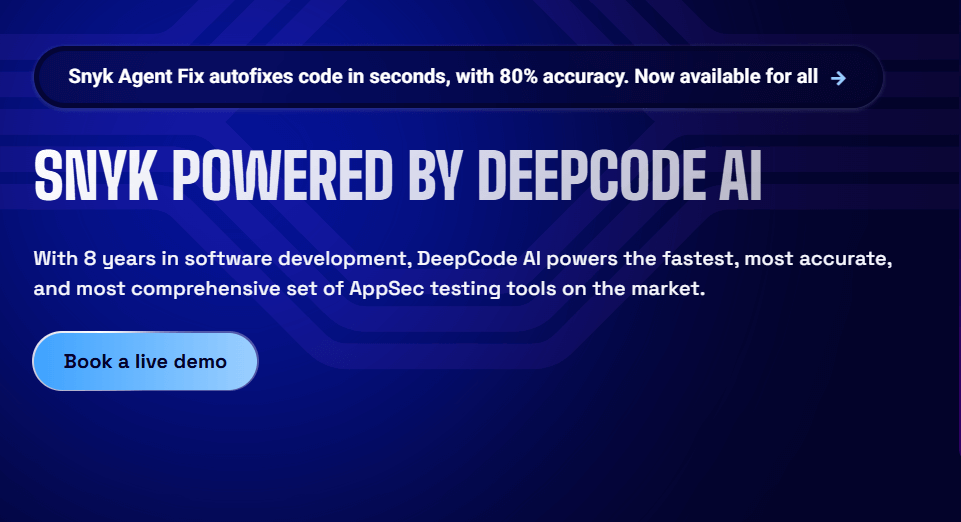
DeepCode AI (via Snyk Code) is an AI-driven static (and semantic) code-analysis tool. It integrates into development workflows (IDE, CI/CD, repos) to automatically scan code for security vulnerabilities, logic/quality issues, and code-patterns. It provides alerts, fix suggestions, and integrates into pull requests, branches and developer tools.

  • Traditional static-analysis and code review are often slow, fragmented, or miss subtle issues, especially as teams scale and codebases grow. DeepCode AI helps “shift left” by giving feedback earlier (in IDE/PR).
  • Especially relevant in contexts where security, regulatory compliance or high-velocity dev are important (e.g., SaaS, cloud, open-source, microservices).
  • It also helps enforce coding standards, reduce technical debt, and provides one place for code-review + vulnerability scanning.

Details

Tool Launch / Founded Date

2018

Best for

Engineering teams (5+ devs) wanting automated code review and security feedback DevOps/DevSecOps teams requiring shift-left scanning and integration into CI/CD SaaS, cloud, open-source projects where code velocity is high and risk needs to be managed

Access Type

Freemium (free tier) + Paid subscription (seat-based) + custom enterprise plans

Licensing Model

Proprietary (via Snyk). Users generally have commercial rights to run scans on their code. Training data uses permissively licensed open-source projects — Snyk says they do not use customer code for model training.

Feature

  • Real-time analysis of code (IDE, pull request) to surface security and quality issues. 
  • Hybrid AI approach (symbolic + ML) supporting multiple languages (~19+ languages) and large data-flow knowledge bases (25M+ cases) for better precision. 
  • Autofix suggestions in IDE or via CI/CD pipelines (for supported rules) to reduce developer time.
  • Integration with CI/CD, GitHub/GitLab/Bitbucket, IDEs, and DevSecOps workflows. 
  • Custom rule creation and search for matching code-patterns, enabling teams to enforce internal standards.

Pricing Tables

Free
$0 per contributing developer (monthly)
  • Unlimited contributing developers
  • Limited number of tests/scans (for Snyk Code: up to ~100 tests/month)
Team
$25/month
  • Minimum 5 contributing developers (up to 10)
  • Includes Snyk Code tests (SAST) + other features
Enterprise
Custom pricing

For larger teams, custom deployment, advanced features (e.g., self-hosted, full SLAs).

Analytics

Traffic Analysis

Domain Rating
28
Organic Traffic
170
Majority Users
United States

Visits Over Time

No visit data found.

Traffic Sources

No traffic data found.

Last Update Date: 2025-11-28

FAQ

Can I use DeepCode AI to scan my private repositories commercially?
Yes — with the appropriate plan (e.g., Team or Enterprise via Snyk Code) you can scan private repos and use it in commercial settings. The free plan may have limitations in test volume.
How many languages does it support?
The vendor claims support for 19+ programming languages and large data-flow coverage (25M+ cases) for scanning
Does it integrate into my IDE and CI/CD?
Yes — DeepCode AI offers IDE plugins (VS Code, JetBrains) and integrates with GitHub/Bitbucket/GitLab and CI workflows.
Are fixes automatically applied?
The tool offers “autofix suggestions” for many issues (especially security patterns) that developers can apply. But full automatic remediation without review is not typical — you still review changes.
Does my code get used to train the models?
According to Snyk, no — they train on permissively licensed open-source data and do not use customer code to train their models by default.
What does the top plan (Enterprise) add that the Team plan doesn’t?
On Enterprise you get greater scale (many devs/repos), self-hosting options (code scanning inside your network), richer analytics, advanced policy enforcement, and likely SLAs and support.
What are typical limitations I should watch out for?
Limitations include scan volume caps on lower tiers, language/frameworks not covered equally, potential false positives or needed tuning for custom code patterns, and cost scaling for large teams.

Related AI Tools

JimmyGPT is an AI chatbot tool that helps individuals chat, brainstorm, and get coding or writing assistance through
Dreamland Stories is a tool that helps kids create personalized AI-generated stories with images and narration so they
WriteMyEssay.ai is a tool that generates academic essays, outlines, and citations for students so they can draft papers
StoryHero is an AI storytelling tool that creates personalized illustrated stories for children so parents, teachers, and kids
MindChat is a mental wellness and concussion monitoring platform that combines AI assessments with EEG data for clinicians,
FanFicGen is a tool that generates AI-written fan fiction stories for fandom creators so they can brainstorm plots,