
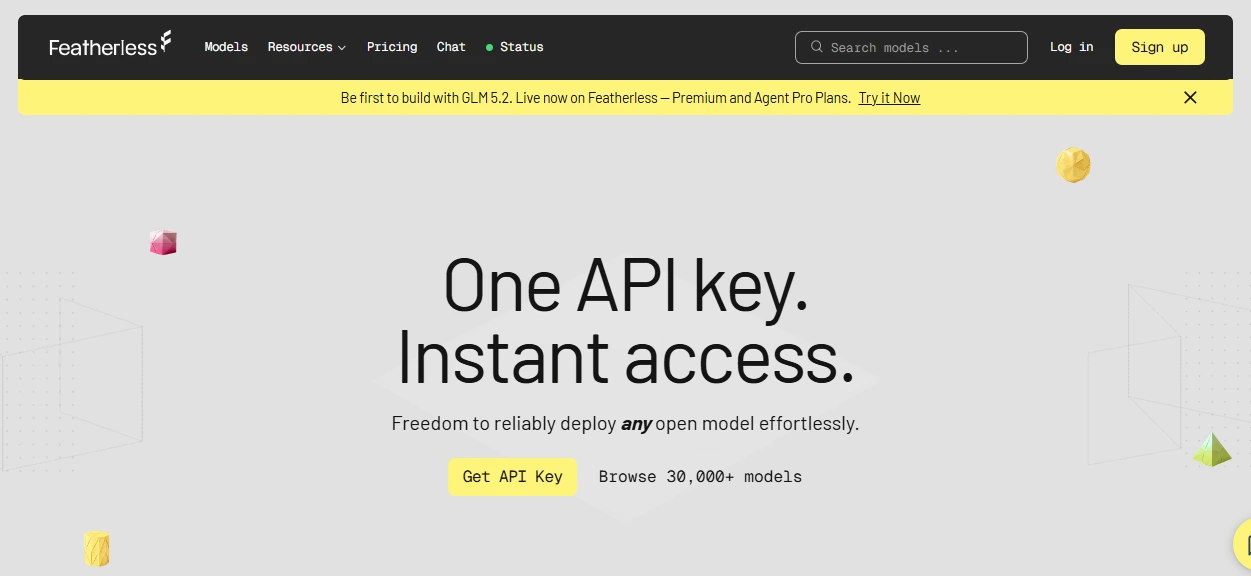
Featherless is a serverless AI inference platform focused on open-source models. Instead of hosting models yourself on expensive GPUs, you can access thousands of models through a single API.
The platform is built around Hugging Face-compatible workflows and OpenAI-style APIs, making it easier for developers to swap between models without rebuilding their stack.
It’s mainly aimed at developers, AI startups, research teams, agent builders, and hobbyists experimenting with open-weight LLMs.
Running large AI models is expensive and operationally messy. Most teams either:
- pay for dedicated GPU infrastructure, or
- use providers with limited model catalogs.
Featherless tries to solve both problems at once:
- huge model variety,
- no infrastructure management,
- predictable subscription pricing.
It’s especially useful if you:
- test many open-source models,
- build AI agents,
- run roleplay/chat apps,
- prototype AI products quickly,
- want alternatives to OpenAI-only workflows.
The “unlimited requests with concurrency limits” model is also attractive for heavy experimentation compared to token-based billing.
You connect to Featherless through an OpenAI-compatible API endpoint. The platform dynamically loads and serves models from a large catalog that includes:
- Llama models,
- Qwen,
- DeepSeek,
- roleplay fine-tunes,
- coding models,
- multimodal models.
The platform handles:
- GPU allocation,
- scaling,
- model orchestration,
- inference serving.
Developers can integrate through:
- direct REST APIs,
- OpenAI SDK compatibility,
- LangChain,
- LiteLLM,
- Hugging Face Inference Providers.
Watch-outs
- Pricing is concurrency-based rather than token-based, which can confuse new users.
- Some advanced features available on enterprise AI providers are still limited.
- Tool calling and structured outputs are not universally supported across all models.
- Model quality varies heavily because the catalog includes many community fine-tunes.
- Context length and performance depend on the selected model and plan tier.