
reflex_dev_logo

Reflex.dev

Rating: 4.3
User Satisfaction: 78%
Reflex.dev is a framework that lets Python developers create full-stack web applications with UI, backend logic, and deployment using only Python so they can build, iterate, and ship apps faster

Alternative To

Overview

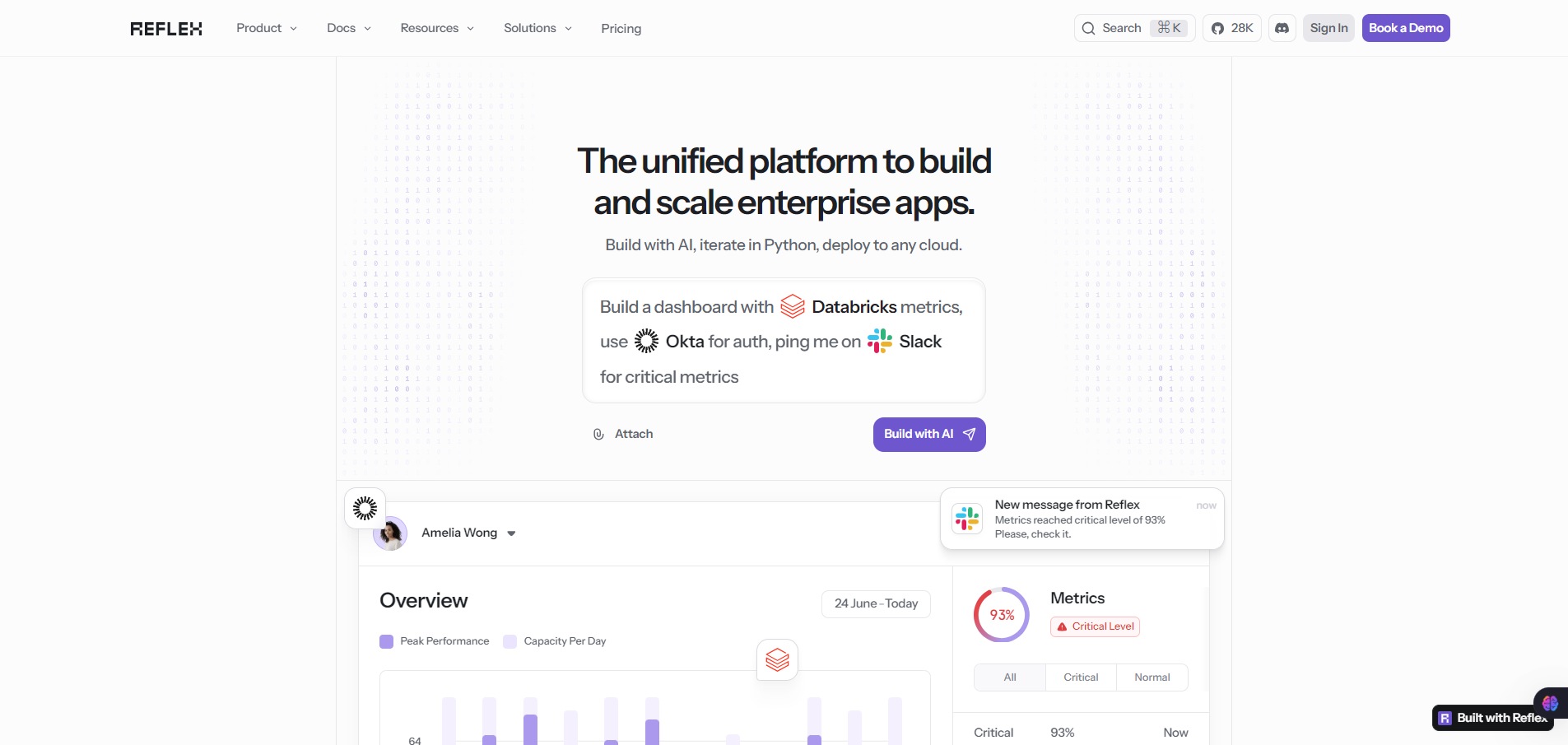
Reflex (formerly Pynecone) is an open-source Python framework for building full-stack web applications entirely in Python. It removes the need to write JavaScript or use separate frontend frameworks by compiling your Python code into both frontend and backend assets.  

Traditional web development requires separate languages for frontend (e.g., JavaScript/React) and backend (e.g., Python/Flask). Reflex simplifies this by letting you write your UI, state management, and backend logic in a single language — Python — reducing context switching and boilerplate.  

You install and import the Reflex Python package, define UI components and application state in Python, and run a development server. Reflex translates the Python UI into frontend code (built on frameworks like Next.js/React) and ties it to a backend (e.g., FastAPI) with real-time interactivity over WebSockets. Deployment can be done via built-in commands or hosted services.

Details

Tool Launch / Founded Date

Originally introduced as Pynecone, rebranded as Reflex; company founded ~2023.

Best for

Python developers, engineers without frontend expertise, teams building internal data apps, dashboards, or prototypes

Access Type

Free, open-source framework (Apache-2.0) with optional hosted services for cloud deployment

Licensing Model

Apache-2.0 open source; commercial rights included under standard open-source terms

Feature

  • Write full-stack UI and backend logic entirely in Python — no hand-written JavaScript.  
  • Fast live reload development server and stateful components.  
  • Over 60+ built-in UI components and theming support.  
  • Real-time interactivity via backend-driven WebSockets.  
  • Optional AI-powered app generator (Reflex Build) to scaffold apps from prompts. 
  • Built-in deployment tooling and hosting options

Pricing Tables

Pricing Model
Free
  • Reflex itself is open-source and free to use. Hosted deployment and enterprise plans (cloud hosting, team features) may have paid tiers, but details are typically on request or in hosted service documentation.

Analytics

Traffic Analysis

Domain Rating
73
Organic Traffic
135.06K
Majority Users
United States

Visits Over Time

No visit data found.

Traffic Sources

No traffic data found.

Last Update Date: 2026-02-04

FAQ

Can I deploy Reflex apps anywhere?
Yes — apps can be deployed via built-in commands, hosted reflex services, or on cloud infrastructures like AWS, GCP, etc.
Do I need to know JavaScript?
No — you write UI and backend logic in Python; Reflex handles the frontend compilation.
Is Reflex suitable for enterprise apps?
It’s used by enterprise teams for internal tools and data apps and offers deployment and scaling features.
How interactive are Reflex apps?
Very — Reflex uses WebSockets for real-time state syncing between client and server.
Does Reflex replace frameworks like Django?
Not really; Reflex is an alternative for building modern interactive apps, while Django is a general web framework; choice depends on app needs.

Related AI Tools

Idea Generators is an AI brainstorming tool that generates content and business ideas for creators, marketers, and online
MissionMapper is a tool that helps individuals create personal mission statements and clarify their goals, values, and purpose
JimmyGPT is an AI chatbot tool that helps individuals chat, brainstorm, and get coding or writing assistance through
Dreamland Stories is a tool that helps kids create personalized AI-generated stories with images and narration so they
WriteMyEssay.ai is a tool that generates academic essays, outlines, and citations for students so they can draft papers
StoryHero is an AI storytelling tool that creates personalized illustrated stories for children so parents, teachers, and kids