Radicle logo

Radicle

Rating: 4.2/5
User Satisfaction: 84.0%
Radicle is a developer platform that lets teams host, share, and collaborate on Git repositories over a peer-to-peer network so they can work without relying on centralized servers.

Alternative To

Overview

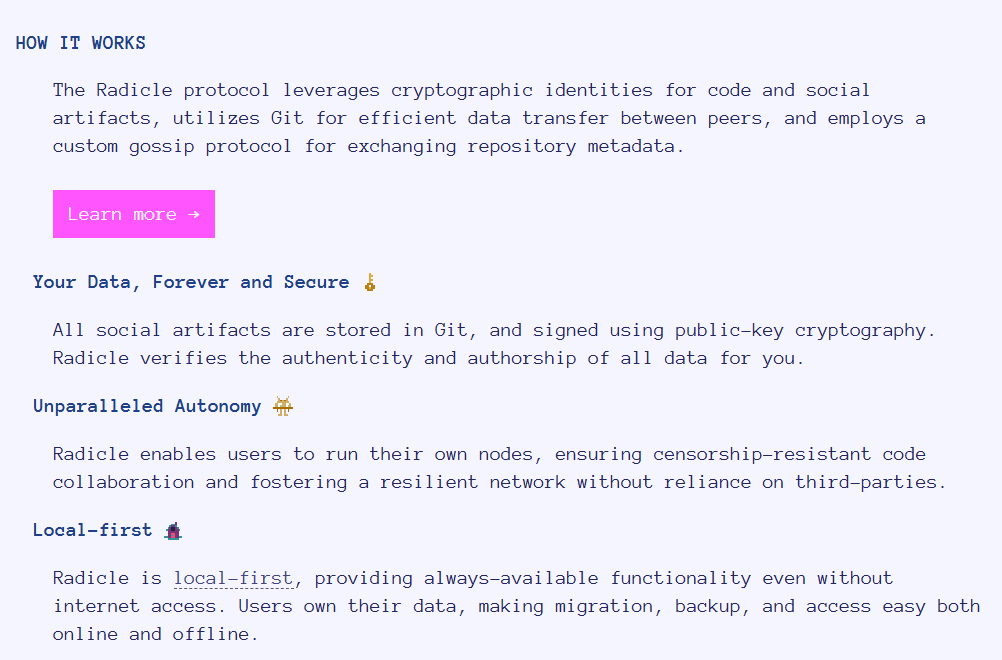
Radicle is an open, peer-to-peer code collaboration network built on top of Git. Instead of storing your code on a central provider like GitHub or GitLab, Radicle distributes repositories across a decentralized network. You work from your local machine, choose who you follow, and replicate code through peers you trust.

If you want full control of your code without renting a remote platform, Radicle gives you that. It removes single points of failure, service shutdown risks, and platform lock-in. Developers who care about sovereignty, open-source workflows, censorship resistance, or long-term archiving get the most value. Teams working in sensitive or highly private environments also benefit from avoiding centralized hosting.

Radicle runs using a local app or CLI that manages your identity, remotes, and project replication. Repositories sync via a peer-to-peer protocol, and collaborators fetch updates from the peers they follow. You can use code review, issues, patches, and discussions inside the Radicle client. Projects are identified by unique decentralized IDs rather than URLs.

Details

Tool Launch / Founded Date

2021

Best for

Developers, open-source maintainers, privacy-focused teams, security-sensitive organizations, and communities looking for a non-centralized Git workflow.

Access Type

Free, open-source. No paid plans.

Licensing Model

Open-source (various repos under permissive licenses such as GPLv3 or similar—project is fully open). Users maintain all rights to their code; Radicle does not own hosted content.

Feature

  • Peer-to-peer Git repository sharing without central servers.
  • Local-first development—repositories live on your machine.
  • Unique decentralized project IDs for long-term addressability.
  • Code review, patches, issues, and discussions baked into the client.
  • Social-graph-based discovery: follow peers to sync their projects.
  • Optional seed nodes for always-online mirroring.
  • CLI and desktop app available for all major OSes.
  • Open protocol—anyone can build clients or extensions around it.

Pricing Tables

Radicle is free
no paid plans

 There are no paid plans, no usage tiers, and no subscription model.

Analytics

Traffic Analysis

Domain Rating
67
Organic Traffic
597
Majority Users
United States

Visits Over Time

No visit data found.

Traffic Sources

No traffic data found.

Last Update Date: 2025-12-06

FAQ

Is Radicle a replacement for GitHub?
Partially. It replaces repo hosting and basic collaboration but doesn’t match GitHub’s ecosystem or integrations. It’s strongest when you want decentralized control rather than cloud convenience.
Can I use Radicle for private code?
Yes. Everything is local-first, and you choose which peers see your data. Sharing is opt-in, and you control what gets replicated.
Does Radicle support issues and pull requests?
It supports issues, patches (pull request equivalents), and discussions, though the workflow is different and more Git-native.
Do I need my own server?
No. Radicle works peer-to-peer. But if you want your project to be available 24/7, you can run a seed node.
Does Radicle train on my data?
No. Nothing is centrally stored or processed. Your code never enters a proprietary training pipeline.
Does it integrate with CI/CD tools?
Not natively. You’ll need external tooling or custom setups. The ecosystem is still growing.
Who supports Radicle?
The Radicle Foundation and the broader open-source community maintain the protocol and client.

Related AI Tools

JimmyGPT is an AI chatbot tool that helps individuals chat, brainstorm, and get coding or writing assistance through
Dreamland Stories is a tool that helps kids create personalized AI-generated stories with images and narration so they
WriteMyEssay.ai is a tool that generates academic essays, outlines, and citations for students so they can draft papers
StoryHero is an AI storytelling tool that creates personalized illustrated stories for children so parents, teachers, and kids
MindChat is a mental wellness and concussion monitoring platform that combines AI assessments with EEG data for clinicians,
FanFicGen is a tool that generates AI-written fan fiction stories for fandom creators so they can brainstorm plots,