

Chemistry is a field of science that requires precision, efficiency, and advanced analytical techniques. Whether you’re conducting experiments in a lab, studying chemical reactions, or teaching chemistry concepts, the right tools can significantly enhance your understanding and productivity. With the rise of artificial intelligence, AI tools for chemistry are now transforming how students, researchers, and professionals engage with this discipline.
AI-powered chemistry tools can automate complex calculations, model chemical reactions, and analyze vast amounts of data to generate valuable insights. In this article, we will explore the top 10 AI tools for chemistry, discussing their features, benefits, and pricing to help you choose the right tool for your needs. These tools can assist with chemistry study tools, chemistry teaching tools, and even professional analytical chemistry tools, making them invaluable for anyone involved in the field.
What Are Tools for Chemistry?
Tools for chemistry refer to a wide range of instruments, software, and devices designed to assist in various aspects of chemistry. These tools are used in chemical experiments, chemical analysis, teaching, and research. Some tools are physical instruments like chemistry measuring tools and chemistry mixing tools, while others are digital platforms and software like chemistry software tools and AI-powered applications. With the integration of AI, many of these tools now offer more accurate and efficient solutions, enhancing productivity in labs and classrooms alike.
In addition to laboratory tools, AI tools for chemistry also support tasks such as chemical modeling, data analysis, and simulation of chemical reactions. Whether you’re learning chemistry, teaching it, or conducting research, the right chemistry AI tools can significantly streamline your workflow and improve results.
Benefits of Chemistry Tools
- Accuracy and Precision: Tools designed for chemistry help ensure experiments are conducted with the highest level of precision, reducing errors in measurements and calculations.
- Time Efficiency: Automation of complex tasks, such as data analysis or chemical modeling, saves significant time for researchers and students.
- Improved Learning: AI-powered tools offer interactive and visual ways to learn chemistry concepts, helping students grasp complex topics.
- Data Analysis: Advanced tools for chemistry are capable of analyzing large datasets and making predictions, which is particularly useful in research.
- Green Chemistry: Many tools now support green chemistry, which focuses on developing chemical processes that are environmentally friendly and sustainable.
Top 10 AI Chemistry Tools Tools
- ChemDraw
- MestReNova
- Labster
- Reaxys
- ChemSketch
- Avogadro
- TinkerCAD
- AI Chemist
- Sage Chemistry
- Matlab
Comparison Table
| Tool | Best For | Key Features | Pricing |
|---|---|---|---|
| ChemDraw | Chemical drawing and modeling | 2D/3D molecular structure, Reaction simulation | Starts at $200/year |
| MestReNova | Data analysis | NMR spectroscopy, Data interpretation | Starts at $800/year |
| Labster | Virtual labs and experiments | Virtual chemistry labs, Simulations | Starts at $29/month |
| Reaxys | Chemical database and research | Reaction search, Chemical data analysis | Custom pricing |
| ChemSketch | Molecular structure drawing | 2D/3D drawing, Chemical formula generation | Free/Paid plans |
| Avogadro | Molecular visualization | 3D molecular modeling, Chemical visualization | Free |
| TinkerCAD | 3D modeling for chemistry | 3D printing, CAD tools for chemical projects | Free |
| AI Chemist | Predicting chemical reactions | AI-based reaction prediction, Analysis | Custom pricing |
| Sage Chemistry | Chemical synthesis | Reaction pathways, Synthesis planning | Starts at $150/month |
| Matlab | Scientific computing | Mathematical modeling, Chemical analysis tools | Starts at $50/month |
1. ChemDraw
Review: ChemDraw is one of the most widely used tools for chemical drawing and modeling. It enables chemists and students to create 2D and 3D molecular structures, draw chemical reactions, and simulate chemical processes. ChemDraw integrates with other software tools, making it a comprehensive solution for chemical design and research.
Best For: Chemical drawing and reaction simulation.
Features: 2D/3D molecular structure, Reaction simulation, Integration with other tools.
Pros:
- Highly regarded in the chemistry community.
- Intuitive interface for drawing molecular structures.
- Powerful tools for drawing and simulating chemical reactions.
Cons:
- Expensive for individual users.
- Learning curve for beginners.
Pricing: Starts at $200/year.
2. MestReNova
Review: MestReNova is an advanced software tool for processing and analyzing NMR (Nuclear Magnetic Resonance) spectroscopy data. It’s widely used in chemical research for interpreting complex molecular data. The AI-powered features of MestReNova help automate data analysis, making it easier to extract valuable insights from spectroscopic experiments.
Best For: Data analysis in chemical research.
Features: NMR spectroscopy, Data interpretation, Automation tools.
Pros:
- Powerful data analysis capabilities.
- Supports a wide range of spectroscopy techniques.
- Intuitive interface for complex chemical data.
Cons:
- High pricing for smaller institutions.
- Requires NMR data for full functionality.
Pricing: Starts at $800/year.
3. Labster
Review: Labster is a virtual lab simulation platform that enables students to perform chemistry experiments in a virtual environment. With Labster, students can engage in interactive experiments, which provide a hands-on learning experience without the need for physical lab equipment. This tool is perfect for teaching chemistry concepts in an engaging way.
Best For: Virtual labs and chemistry experiments.
Features: Virtual chemistry labs, Interactive simulations, Educational content.
Pros:
- Provides an immersive learning experience.
- Covers a wide range of chemistry topics.
- Accessible online, no physical lab required.
Cons:
- Subscription-based pricing can be high.
- Limited to the simulations available in the platform.
Pricing: Starts at $29/month.
4. Reaxys
Review: Reaxys is an extensive chemical database and research tool that provides access to detailed information on chemical reactions, substances, and properties. It is widely used in academia and industry for finding chemical data, understanding reactions, and sourcing reliable scientific articles. AI-powered search and analytics make Reaxys an invaluable tool for chemistry researchers.
Best For: Chemical research and data access.
Features: Reaction search, Chemical data analysis, Scientific literature access.
Pros:
- Comprehensive and reliable chemical database.
- Offers AI-powered reaction prediction.
- Extensive research library with peer-reviewed articles.
Cons:
- Expensive for individual users.
- Custom pricing, which may be out of reach for smaller institutions.
Pricing: Custom pricing.
5. ChemSketch
Review: ChemSketch is a free chemical drawing tool that allows users to create 2D and 3D molecular structures, chemical formulas, and reactions. It’s ideal for students and professionals who need a simple yet effective tool for drawing chemical structures. ChemSketch also supports integration with other software for more advanced analysis.
Best For: Molecular structure drawing and basic chemical design.
Features: 2D/3D molecular structure drawing, Chemical formula generation, Free version available.
Pros:
- Free version available with essential features.
- User-friendly interface.
- Allows for the creation of complex molecular structures.
Cons:
- Lacks advanced analysis tools.
- Limited integration with other platforms.
Pricing: Free, with paid versions offering additional features.
6. Avogadro
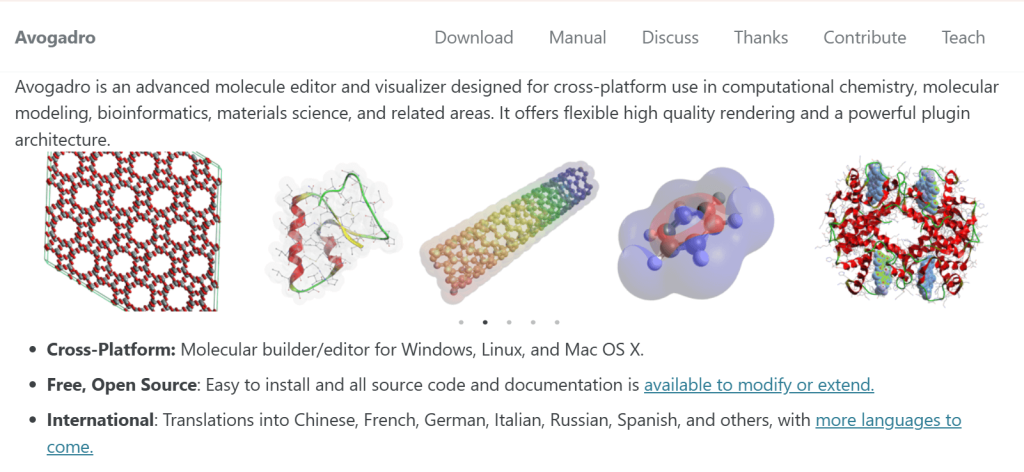
Review: Avogadro is an open-source molecular visualization tool used to model and visualize molecular structures. It’s ideal for researchers and students who need a free, flexible tool to view and manipulate 3D molecular models. Avogadro is compatible with many molecular data formats and integrates with other computational chemistry software.
Best For: Molecular visualization and modeling.
Features: 3D molecular modeling, Visualization tools, Molecular file support.
Pros:
- Completely free and open-source.
- Highly customizable and extensible.
- Great for viewing and editing molecular structures.
Cons:
- Limited to visualization and basic editing.
- Steep learning curve for beginners.
Pricing: Free.
7. TinkerCAD

Review: TinkerCAD is a 3D design and modeling tool that can be used for creating chemical models. While it’s typically used for general 3D modeling, it can also be applied to create molecular models and simulations in chemistry. It’s especially useful for students looking to visualize complex chemical structures.
Best For: 3D modeling for chemistry projects.
Features: 3D modeling, CAD tools, Integration with 3D printing.
Pros:
- Free and easy to use.
- Great for 3D printing chemical models.
- Interactive and educational.
Cons:
- Not specifically designed for chemistry modeling.
- Limited to 3D design and lacks advanced chemical analysis features.
Pricing: Free.
8. AI Chemist
Review: AI Chemist is an advanced AI-powered tool designed to predict chemical reactions. By inputting the necessary reactants, users can predict possible chemical outcomes, making it easier to design and optimize experiments. AI Chemist is ideal for researchers working with complex chemical synthesis and reaction modeling.
Best For: Predicting chemical reactions.
Features: AI-based reaction prediction, Reaction analysis, Data interpretation.
Pros:
- AI-powered predictions increase accuracy.
- Ideal for optimizing chemical reactions.
- Streamlines experimental design.
Cons:
- Custom pricing makes it inaccessible for some users.
- Requires detailed input for accurate predictions.
Pricing: Custom pricing.
9. Sage Chemistry
Review: Sage Chemistry is a powerful tool designed for chemical synthesis planning. It provides users with reaction pathways, helps predict reaction outcomes, and assists with synthesis strategies. This tool is particularly useful for researchers working in organic chemistry and synthetic chemistry.
Best For: Chemical synthesis and reaction pathways.
Features: Reaction pathways, Synthesis planning, Reaction predictions.
Pros:
- Powerful and intuitive synthesis tool.
- Great for designing chemical reactions.
- Supports various organic chemistry applications.
Cons:
- Pricing can be prohibitive for smaller labs.
- Limited to chemical synthesis.
Pricing: Starts at $150/month.
10. Matlab
Review: Matlab is a high-level programming platform used for scientific computing. In chemistry, Matlab can be used for modeling, data analysis, and simulation of chemical processes. It’s ideal for researchers working with complex mathematical models or simulations in chemistry.
Best For: Scientific computing and simulation.
Features: Mathematical modeling, Chemical process simulation, Data analysis tools.
Pros:
- Powerful and versatile for scientific research.
- Excellent for mathematical modeling and simulations.
- Supports advanced data visualization.
Cons:
- High pricing.
- Requires programming knowledge.
Pricing: Starts at $50/month.
How to Choose the Best AI Tools for Chemistry
When selecting the best AI tools for chemistry, consider the following:
- Specific Needs: What aspect of chemistry are you focusing on? Whether it’s molecular modeling, chemical synthesis, or reaction prediction, choose a tool that fits your research or learning needs.
- User-Friendly Interface: If you are new to AI tools, opt for those with intuitive interfaces.
- Pricing: Some tools offer free versions, while others require subscriptions. Choose according to your budget and required features.
- Integration: Ensure that the tool integrates well with other platforms you use, such as lab equipment, simulation software, or academic databases.
Conclusion
AI tools for chemistry are transforming the way students, educators, and researchers approach chemistry tasks. From molecule modeling to reaction prediction, these tools are streamlining chemical research and learning. By selecting the right AI tool for your needs, you can enhance the accuracy, efficiency, and creativity of your chemistry projects.
FAQ
What are AI tools for chemistry?
AI tools for chemistry are software applications powered by artificial intelligence that assist with various chemistry-related tasks, including molecular modeling, chemical reaction prediction, data analysis, and research.
Which AI tool is best for chemistry research?
Reaxys and AI Chemist are among the best AI tools for chemistry research, offering comprehensive databases and AI-powered reaction predictions.
Are there free AI tools for chemistry?
Yes, tools like Avogadro, ChemSketch, and TinkerCAD are free and can be used for tasks like molecular visualization and drawing.
How do AI tools help in chemistry?
AI tools in chemistry assist with tasks like predicting chemical reactions, optimizing experiments, modeling molecular structures, and analyzing chemical data, making research more efficient and accurate.
Can AI tools replace traditional chemistry methods?
While AI tools greatly enhance the efficiency and accuracy of chemistry tasks, they are meant to complement traditional methods, not replace them entirely.

