


In today’s fast-paced business environment, customers expect fast, efficient, and personalized support. To meet these demands, many companies are turning to AI tools for customer service. These tools harness the power of artificial intelligence to automate customer support processes, enhancing response times and customer satisfaction while reducing the operational cost.
But with so many options out there, how do you know which AI tools will best suit your business? In this article, we will review the top 10 AI customer service tools, exploring their features, benefits, and pricing to help you make an informed decision.
What Are AI Tools for Customer Service?
AI tools for customer service are software platforms that utilize artificial intelligence, machine learning, and natural language processing (NLP) to automate and enhance customer service tasks. These tools are designed to handle repetitive tasks such as answering customer queries, routing requests, and analyzing customer data. They improve operational efficiency and help businesses deliver high-quality, scalable customer service 24/7.
Benefits of AI Customer Service Tools
- Efficiency and Speed: AI-powered tools can respond to customer inquiries instantly, ensuring fast resolution times.
- Cost Reduction: By automating tasks, businesses can reduce the need for large customer service teams, saving on labor costs.
- Personalized Experience: Many AI tools analyze customer data to provide tailored responses, making each interaction feel personalized.
- Scalability: AI customer service tools can handle an unlimited volume of inquiries, making it easy for businesses to scale their operations without compromising quality.
- Improved Customer Satisfaction: With faster response times and fewer human errors, AI tools often lead to higher customer satisfaction rates.
Top 10 AI Customer Service Tools
-
Yuma
-
Wonderchat
-
Drift
-
Intercom
-
LivePerson
-
Ada
-
DevRev
-
Kustomer
-
Gladly
-
Genesys
Comparison Table
| Tool | Best For | Key AI Strength | Pricing (Starting) |
|---|---|---|---|
| Yuma | E-commerce CX automation | Automated ticket resolution + agentic workflows | Performance-based + free trial |
| Wonderchat | Website AI chatbot (no-code) | Train bot on site/docs + live chat handoff | From $15.99/mo; higher tiers available |
| Drift | Sales + support conversations | Conversational routing + meeting booking | Contact sales (varies by package) |
| Intercom | AI customer service + messaging | Fin AI agent + automation | From $29/mo + $0.99/resolution |
| LivePerson | Enterprise conversational AI | AI orchestration across digital + voice | Custom quote |
| Ada | Enterprise AI agent automation | Omnichannel automated resolutions | Usage-based / custom quote |
| DevRev | Support + product collaboration | AI + workflows bridging support & engineering | From $19.99/user/mo (Starter) |
| Kustomer | Customer service CRM | Unified customer view + AI agents | From $89/user/mo (Enterprise shown) |
| Gladly | B2C “customer-first” CX | Continuous conversation + Customer AI | Custom pricing (no public tiers) |
| Genesys | Contact centers (omnichannel/voice) | AI routing + bots + analytics | From $75/user/mo (CX 1) |
1. Yuma

Review: Yuma focuses heavily on e-commerce customer support automation, aiming to resolve repetitive tickets quickly and consistently while keeping quality high. It’s positioned as an “agentic AI” platform across the customer journey, with an emphasis on measurable outcomes.
Best For:
-
Shopify/e-commerce brands handling high ticket volume
-
Teams wanting automation tied to outcomes (not seats)
Key Features:
-
AI support automation for common tickets
-
End-to-end “agentic” workflows across customer interactions
-
Security-focused enterprise setup
Pros:
-
Built specifically for e-commerce support needs
-
Outcome/performance-oriented approach
Cons:
-
Best fit if you’re primarily e-commerce
-
Pricing can be less “predictable” than flat-seat models
Pricing:
-
Performance-based billing + free trial available
2. Wonderchat

Review: Wonderchat is a no-code AI chatbot builder that can be trained on your website/help content and deployed quickly. It’s popular for teams that want fast self-service with optional live chat handoff and helpdesk escalation.
Best For:
-
Small-to-mid teams that want a fast “train-on-your-content” chatbot
-
Website support + lightweight automation
Key Features:
-
Live chat + AI-to-human handover
-
Ticket/helpdesk escalation options
-
Message credits-based plans (tiers)
Pros:
-
Very quick to deploy
-
Clear tiering for scaling usage
Cons:
-
Costs rise as usage/message credits grow
-
Advanced enterprise needs may require higher tiers
Pricing:
-
Starts at $15.99/month on Wonderchat’s pricing page
-
Shopify listing shows tiers including $99.99/mo, $249.99/mo, $499.99/mo (depending on plan/credits)
3. Drift

Review: Drift is a powerful AI-powered conversational marketing and sales platform. Drift’s AI chatbots help businesses convert website visitors into leads by automating live chat interactions and providing personalized responses. Its seamless CRM integrations and robust reporting features make it a go-to solution for businesses focused on growing their customer base.
Best For: Conversational marketing and lead generation.
Features: AI-powered chat, CRM integrations, Email automation, Real-time analytics.
Pros:
- Excellent for lead generation.
- Powerful integrations with CRMs.
- Personalizes conversations using AI.
Cons:
- More suitable for sales teams than traditional customer support.
- Pricing can be expensive for small businesses.
Pricing: Starts at $50/month.
4. Intercom
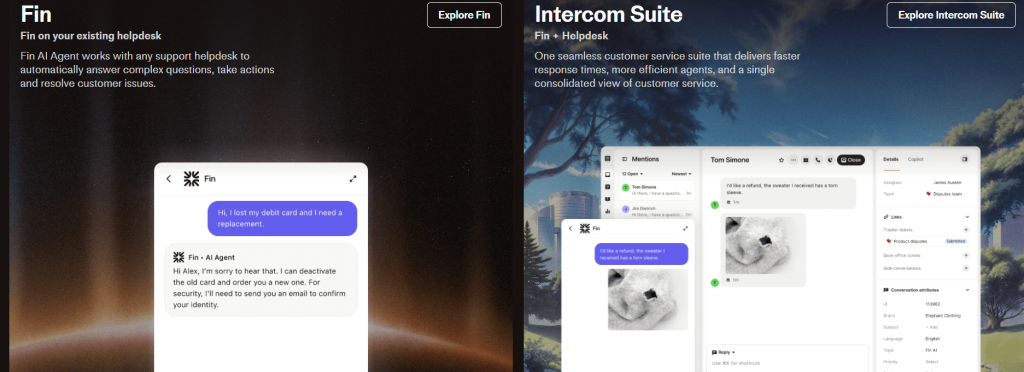
Review: Intercom is a comprehensive customer messaging platform that offers powerful AI chatbots to automate responses and support. Its automation features help businesses respond to customers quickly, while its robust integrations allow seamless communication across various platforms.
Best For: Customer messaging and automation.
Features: AI chatbots, Messaging, Automations, Integrations.
Pros:
- User-friendly interface.
- Robust automation capabilities.
- Integrates with a wide range of apps and platforms.
Cons:
- Can be complex to set up initially.
- Pricing can be on the higher end.
Pricing: Starts at $39/month.
5. LivePerson
Review: LivePerson is a cloud-based messaging platform with an emphasis on AI-powered chatbots and real-time messaging. With its AI features, businesses can automate routine queries and provide more personalized support to customers through messaging platforms like SMS, WhatsApp, and Facebook Messenger.
Best For: AI chatbots and messaging automation.
Features: AI chatbots, Messaging, Analytics, Omnichannel support.
Pros:
- Strong analytics and reporting.
- Excellent omnichannel capabilities.
- Customizable chatbot features.
Cons:
- Pricing can vary significantly depending on the number of users.
- Steep learning curve for new users.
Pricing: Custom pricing.
6. Ada

Review: Ada is an AI-driven chatbot platform that automates customer service through natural language processing. Its ability to understand complex customer queries and provide accurate responses makes it ideal for businesses looking to automate their support processes. Ada is highly customizable and integrates with various customer service channels.
Best For: Chatbot automation and NLP support.
Features: AI chatbots, Natural language processing, Integrations, Customizable workflows.
Pros:
- Strong AI-driven conversations.
- Easy to integrate with existing tools.
- Great for automating customer service.
Cons:
- Higher pricing for premium features.
- Limited advanced features for smaller businesses.
Pricing: Starts at $99/month.
7. DevRev

Review: DevRev blends customer support with product/engineering collaboration—helpful when support issues frequently involve debugging, product feedback loops, and cross-team workflows. DevRev also offers entry plans and a “start free” onboarding path.
Best For:
-
Tech/SaaS teams connecting support ↔ product ↔ engineering
-
Organizations needing workflow automation beyond ticketing
Key Features:
-
Omnichannel routing + workflows (Starter plan highlights)
-
Collaboration layer that reduces silos between teams
-
“Get started for free” onboarding path
Pros:
-
Strong for complex support that touches engineering
-
Solid workflow/automation story
Cons:
-
May be more than you need for simple support
-
Some pricing details vary by module/package
Pricing:
-
Starter: $19.99 per user/month (as listed on G2)
-
Start free (no credit card required)
8. Kustomer

Review: Kustomer is a customer service platform that offers AI-powered automation and omnichannel support. It helps businesses manage customer interactions more effectively, automating routine tasks and offering deeper customer insights. Kustomer’s customizable workflows and integrations make it a great option for large enterprises.
Best For: Omnichannel support and AI automation.
Features: AI-powered automation, Omnichannel support, Custom workflows, Reporting.
Pros:
- Excellent for omnichannel communication.
- Customizable and scalable.
- Robust analytics.
Cons:
- Pricing is on the higher end.
- Steep learning curve for new users.
Pricing: Custom pricing.
9. Gladly

Review: Gladly is designed around the idea that support should be customer-centered, not ticket-centered, emphasizing continuous conversations across channels and AI that supports relationship-driven CX—especially for B2C brands. Public pricing tiers typically aren’t posted; it’s commonly quote-based.
Best For:
-
B2C brands prioritizing loyalty and “white-glove” experience
-
Teams wanting continuous cross-channel conversations
Key Features:
-
Customer-centric conversation model + Customer AI positioning
-
Cross-channel continuity (conversation doesn’t reset per ticket)
-
Quote-based packaging (no public tiers widely available)
Pros:
-
Excellent for relationship-driven CX
-
Strong positioning for B2C personalization
Cons:
-
Pricing is not transparent for quick comparisons
-
Often better suited to larger teams/budgets
Pricing:
-
Custom pricing (no public pricing tiers)
10. Genesys

Review: Genesys is a customer service platform that offers AI-powered automation and omnichannel support. It helps businesses manage customer interactions efficiently and provides AI-driven insights to enhance customer experience. Genesys is designed for large enterprises and integrates seamlessly with a wide range of applications.
Best For: Large businesses and enterprises.
Features: AI-driven automation, Omnichannel support, Analytics, Integrations.
Pros:
- Ideal for large-scale operations.
- Advanced AI and reporting features.
- Excellent for handling high volumes of customer requests.
Cons:
- Expensive for small businesses.
- Requires a lot of customization to get the most out of the platform.
Pricing: Custom pricing.
How to Choose the Best AI Customer Service Tools
When selecting the best AI customer service tools, consider the following:
- Business Size: Some tools are designed for small businesses, while others cater to large enterprises. Choose accordingly.
- Specific Needs: Whether you need chatbot automation, omnichannel support, or advanced analytics, make sure the tool meets your specific needs.
- Ease of Use: A user-friendly interface can save time during implementation.
- Scalability: Choose tools that can scale with your business as it grows.
- Pricing: Consider both initial and ongoing costs to ensure the tool fits within your budget.
Conclusion
AI tools for customer service are transforming the way businesses interact with customers. The 10 tools reviewed here offer a variety of features to automate support processes, improve efficiency, and enhance customer satisfaction. By choosing the right tool for your needs, you can significantly improve your customer service and stay ahead of the competition.
FAQ
What are AI tools for customer service?
AI tools for customer service use artificial intelligence to automate and enhance customer interactions, improving response times and customer satisfaction.
Are AI customer service tools expensive?
Some tools have affordable pricing for small businesses, while others are better suited for larger enterprises with higher budgets.
How do I choose the best AI customer service tool?
Consider your business size, specific needs, ease of use, scalability, and pricing when selecting an AI tool.
Can AI tools fully replace human customer support?
While AI tools can handle many routine tasks, human support is still necessary for complex or sensitive issues.
Are AI tools for customer service easy to integrate?
Most AI tools offer easy integrations with popular platforms, but the complexity can vary depending on the tool and your existing systems.

